Monday, October 1, 2012

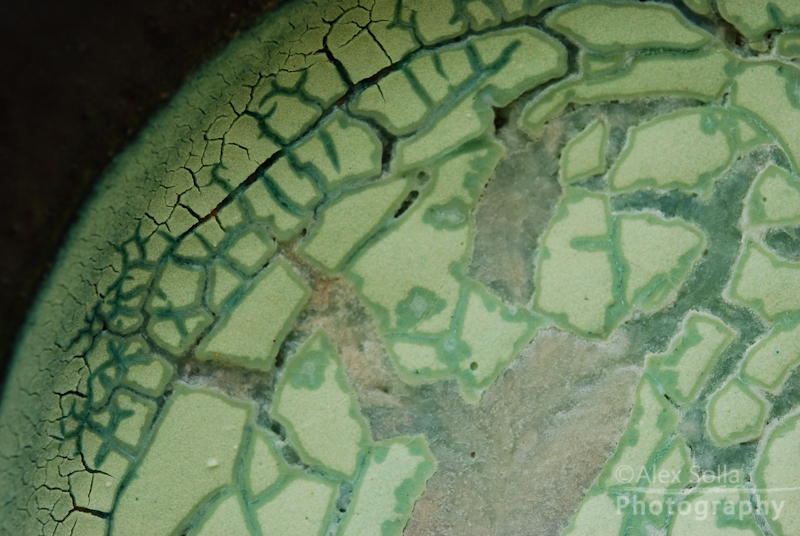
Help a brother out: This Platter Needs a Name (untitled) - 82298B

This Platter needs a name, 82298B, 1998, 26"diameter. 

By the time I was glazing pieces of this size, I was getting some of my technique down. Instead of using the large platters as giant test tiles, they became canvases. I would save my experiments for smaller platters. Anything under 20" in diameter was "small". Easy enough to replace if it should crack in half... which happened all too often.

Once they got this big, and started closing in on the 36" limit... things got tough. It took more bodies to help with all of the various aspects of the making. I needed help flipping them over. I needed help loading them into and out of the kilns. I needed help moving them. They were just HUGE.

Now I need help again. I need suggestions for a name for this platter. Can't guarantee I will use it, but nothing is grabbing now, and back when it was made, I didn't have a name either. For those of you REALLY into helping: I also need to find a venue where I can exhibit these platters. Something, somewhere, where people are excited about seeing and purchasing fine crafts. I am open to all suggestions. If you know of a gallery where these platters NEED to be shown, tell me all about it. If it comes to pass that we are able to show there, we'll work out a way for you to go home with a platter in tow.


Sunday, September 23, 2012

Another Look at the Last Pots

Sometimes it can be hard to look through all the other pots, just to find out that someone swept in and grabbed the one you wanted. So here, in all their glory, are the last pots available. Send me an email, comment on the blog post, or check in with me on FB.

Saturday, September 22, 2012

The last of the last pots... part II

Tangerine canister, 6" tall, $60   SOLD


Cranberry Red canister, 5.25" tall, $60


 Butter Yellow canister, 5.75" tall, $60


 Dark Purple basket, 15" tall, 6.5" wide, $100


 Lime green teabowl, 4"wide, $60


Robin's egg spoonrest, FREE to whomever buys the most pots.   SOLD

One LAST sale, part 1.


If you aren't following me on FB ( facebook.com/AlexanderSolla) , now is when you'll kick yourself. The prices for these pots are clearly marked on my FB page. Seeing as how today is already in a bit of a rush, I wont duplicate that effort here. Suffice to say, these ARE THE LAST OF THE LAST OF THE LAST pots. There are NO MORE. We originally were saving these to give as gifts this holiday season. Unfortunately, we are so busted and broke, that we need the cash to pay the lawyer and surgeons. They get the cash. You get the pots. We get help. Sounds like a plan.

I am trying NOT to ship because it costs so bloody much... but if you decide you have to have 3-4 pots, I will probably find a way to ship it to you.

Lastly, we are only accepting cash and checks. Our credit card machine went bye-bye.

So here they are. First round of images of the pots that are available, for purchase.


SOLD


SOLD


SOLD


SOLD


SOLD


SOLD

SOLD


SOLD

Thursday, September 13, 2012

Seeing Red


In 1992, I started working on developing a copper red glaze that would work consistently in the Alpine updraft gas kiln that we all used at UMASS/Amherst. It had been recently rehabbed by Vince Pitelka, and the kiln was pretty tight. Unfortunately, being an updraft contributed to extremely uneven firings. It was very common to find the pots nearest the bagwall to be under-reduced, or sometimes even oxidized. These two bowls were ones that made it through the firings successfully. The upper image was made from a nice white stoneware I made based on a recipe from Chappell's book. The lower bowl was made from Angela Fina's porcelain recipe.


When I moved to Alfred in 1994, I assumed that I would be doing more copper red glazes. Instead I found myself drawn into ash-glazes and "fake ash" glazes. Something about the rivulet textures and the movement of color was very compelling. As a result, my copper red formulas stayed in the background for quite a while. I came across these bowls today as I was cleaning. Brought back very amusing memories of my first successful firing of an entire load of reds.

Monday, September 3, 2012

More Pots from my Collection

 I am pretty sure this was made by Kelly Sinner at USU.

 I think this one was made by Laura Patterson. Not 100% sure though.

These were made by Mark Lambert, at USU.

Thursday, August 30, 2012

Thinking Back


When I arrived in the town of Logan, back in 1995, I had no idea what grad school would be like. Sure, I had my preconceived notions, but no real clue. Something about the sharp slightly dusty smell that fall carries with it, reminds me of that time in UT. (probably because it is never really that arid here!)


These were pots made by fellow students when I was at Utah State during grad school. I wish I could tell yo more about these pots. USU's program was pretty large and the volume of students who moved through every year was massive. I feel negligent for having not kept in touch with many of my fellow alumns. I guess that is my take-away from this week. Quasi-nostalgia for a difficult time in my life, when the pots were the greatest reward. I don't think I would recognize the face of my next-door neighbor of four years (from UT) if I saw them on the street... but I would never forget these cool pots!


Thursday, August 16, 2012

Grapefruit will break your heart


This was my first successful cylinder, ca. 1989. Made at Barry University in Miami Shores back when my aunt was teaching ceramics there. I had been trying to throw for about a month. Not much was coming off the wheel in one piece. Up until this point, I had been glazing my "pots" with Duncan underglazes and low fire glazes. I was completely bored with the palette of colors and textures that came out of these tiny cups. I wanted stuff with life, texture... what I really wanted was a higher temperature (gas reduction!)... but that was still a ways off.

Seeing my frustration, my aunt suggested I make my own glazes. She handed me Chappell's Potter's Complete Book of Clay and Glazes and said: go to it. I had no idea what these materials were, or how they worked. No clue about toxicity. Not an inkling about protecting my health.

I started reading and found a glaze called Grapefruit Green. I have always been a fool for greens and blues. I thought that Grapefruit Green sounded so cool. I imagined an unripe grapefruit, much like what my parents had in their backyard in Miami. Having hit thousands of them with the lawnmower, I was pretty sure what to expect.

The glaze turned out so incredibly different from what I expected. I think if it had turned out green, it probably would have been tossed like so many of the pots from this era. Instead, it has traveled with me as I have moved across the country so many times. Not a terribly functional size. You can't really drink coffee or tea from it. It holds pennies well. That's about it. The sides and bottom are incredibly thick. As a pot, there is precious little that redeems it. That color however was my first glimpse into a world that would become my life for over 20 years.

Thursday, August 9, 2012

Jason Walker (way waaaay back when)


Nancy and I talk about Jason Walker's work all the time because we see his new work pop up all over. It is featured in magazines (this month's American Craft), websites, pinterest pins... you name it... and he is everywhere. Very VERY cool.

I met Jason when he was finishing up his undergrad work at Utah State in Logan UT. This teabowl was made during that time. His new work is so far removed from this as to seem made by different artists. And yet, when I look at where his work was going before he started working for a sign painter in town... he couldn't have made this teabowl without the fluidity of muscle memory that comes from lots of time behind the brush. His brushwork changed almost overnight. He went from simple overglaze enamels to underglaze work like this in a few short weeks. Amazing!

His new work is no less phenomenal. In fact, it is staggering. I find the imagery so compelling that I plan to write a longer post about it when I finally get to see some in person. I love the work so much that I don't want to comment on it until I can see it, touch it (and get yelled at for touching the work!). Here is a link to his current body of work: http://jasonwalkerceramics.com/portfolio.php?page=collections
From Ferrin Gallery http://ferringallery.com/dynamic/artist.asp?artistID=65

I am frustrated that I can't find other images of his older work. Guess this teabowl will have to do.


I love the penguin in the bottom of this teabowl. Like a little sweet bon mot to brighten your day.

Sunday, July 29, 2012

Ovoid Bottle by Mark Lambert


This paddled, ovoid bottle was made by Mark Lambert while he and I were in school at Utah State University. Mark now teaches in Minnesota. This little woodfired bottle has to be one of the most handled bottles in my collection. Everyone comments on how each side is so different. The extreme flashing and woodash deposit on one side... left the otherside almost a leather brown. Pretty wild considering how small this bottle is. My only regret was not picking out more pots from this firing of Mark's.


Tuesday, July 17, 2012

Compliment-ary Copy


When the March/April 2012 issue of Pottery Making Illustrated arrived back in February, I was surprised. We hadn't had a subscription for probably at least three years. So I opened it up, assuming it was a promotional device, hoping I would come back. Got to the next-to-last page and saw these wonderful drawings of pitcher forms.  As I quickly scanned the page, I thought about how back when I first started making pitchers these were exactly the images I drew my inspiration from... well... except for the folks who weren't even making pots back then (youngsters, lol)....

And as I reached the bottom of the page, I saw our beaked pitcher from way back when. Probably made that blue pitcher back in 2008. I had planned to make a whole series of them. It just never happened. Between a series of rotten shows, health issues and then the coma, they were put on the back burner.

On one hand I am honored to have my pitcher show up in the magazine. On the other hand, no one called or wrote to ask my permission for inclusion in the magazine. Not sure how I feel about that. Seems like a pretty obvious issue of copyright infringement.... but at the same time, I am honored. Such a conundrum. How would you feel seeing your work show up in a magazine, without your foreknowledge?

Monday, July 16, 2012

Certain Dessication - 101198A


Today marks the first substantial rain we have seen since May. Over two months. Less than 1/4 of an inch of rain has fallen. Around here, that is unheard of. Still doesn't qualify as a drought. My yard has never been brown before. Even the weeds have given up the ghost. The clay soil that comprises the bulk of our soil has cracks wide enough to push a finger into. My yard has cracks. Where we should have grass... we have dust.

When I stare into this platter, I am reminded of how fragile our landscape is. Islands that have stood above the sea long enough to develop oral histories of their settling, are now in danger of subsiding under the rising seas. Parts of our own countryside, known for the most varied crops of apples anywhere, this year will produce virtually none. No apples. That means no cider. First world problem? Maybe. But I think it is really more of an indicator of what we have to expect for the near future.

Last year we were inundated with flooding from multiple hurricanes. Fall was torn apart with tornadoes. Winter brought us virtually no snow and warm temperatures. Grass was bright green in March this year, when it should have been buried under a foot of heavy snow. How long until our vernal island between these massive lakes dries up and crumbles? My guess is that the frakking for natural gas (scheduled to begin VERY soon in NY state) will accelerate that process and perhaps even be the tipping point.


Saturday, July 14, 2012

Up From Underneath - 91398B

Up From Underneath - 91398B 

The slow cooling factor of these platters was a direct result of the way they were fired. Imagine the inside of most kilns... a big giant empty chamber surrounded by bricks.... all the fire surrounding the ware on thick shelves. When fired this way, these platters would crack right down the center as they were heating due to the massive thermal shock (the difference between the temperature of the edge of the platter vs the center of the platter). If they were heated too fast, CRACK! Since there are no real windows in kilns, you couldn't tell which platters had cracked, and which had spilled their glaze contents all over the shelves. For the first few months of making these, the loss rates were almost 90%. The cleanup mess was insane. 

To slow down the extreme heat, I decided to create a "muffle" for the ware. By building a baffle of bricks that surrounded the platters, the flame had to heat up the bricks (huge and heavy) before they could begin heating the platters. The upside to this was that cracking dropped dramatically. Unfortunately, by adding all of this excess brick, the firing times increased enormously. From a typical twelve hour cooling time (after a 9 hour firing)... my firing times jumped to 16 hours of firing and over 24 hours of cooling. Within a few months, my firing times extended into days instead of hours. Cooling times extended sometimes for three or more days. 

One of the effects of this radically slow cooling was that the fluid glazes had ample time to recrystallize and form fascinating geological formations. Some of these crystals were so spectacular. Other times, the glazes made the most simple, almost boring, flat shields of matte crystal formations. In this platter, you can see the crystal patterns formed over a fluid glaze underneath. What I initially hoped for is almost impossible to describe. I wanted snowflakes of peach floating on a blue watery field. Due to the extended cooling time, the titanium that was seeding the glaze solution spread and formed thick icy sheets of titania crystals. Looking back at this platter, I wish I had been able to experiment more with this style of glaze. So many opportunities, right under the skin.


More glaze experiments at Glaze Tectonics!

Thursday, July 12, 2012

Dried Up Toothpaste, in Bed (from Glaze Tectonics)


This was another one of those massively wide-lipped platters. Because that rim is actually hollow, it is one of the lighter platters I made. Probably only 15" in diameter, it is a good five pounds lighter than a platter of a "normal" rim.

The inside of this platter was originally supposed to be bright fire-engine red...and crunchy! I think in my hurry to get things ready for this firing, I cut back on my thoroughness in the glaze lab, and didn't mix this glaze as thoroughly as was needed. My guess is that the lead frit in this glaze simple settled in the slurry.

In the end, it is certainly not what I expected, but it also has intriguing aspects. And it does really resemble dried up toothpaste, in bed.


Like what you're seeing here? Check out GLAZE TECTONICS. All platters, all the time. More images, more details, and lots more information about the making of this body of work.