Thursday, June 27, 2013

Caught Cheating With An Old Friend


Back in 2002, Nancy and I took a big leap. While I was recovering from my second back surgery, brought on not by the heavy lifting issues of pottery, but rather by the stresses that came from a desk job at Cornell. Ironic. I worked in an air conditioned library, handling the operations, complaints and billing problems. It should have been a relaxing job, but not at the Hotel School at Cornell. But that is a story for another time...
I want to talk about what I did during my recuperation from my second back surgery.

The leap was to try to get our pottery studio off the ground... to get our work into galleries and to start wholesaling our pots around the northeast. In order to make that happen we visited a newly opened gallery in Watkins Glen in hopes that the owner would be willing to purchase our pots wholesale. He asked for a price list and we were incredibly unprepared. I had expected that he would want to see pots in hand, not some price list.

After getting turned down flatly, we licked our wounds and started figuring out what we would need to do to create better promotional materials for the studio. We knew we needed a price list that reflected our broad range of glazes that could be had on about sizteen different forms at the time. Unfortunately, we didn't own a digital camera so we borrowed one from the tech department at the Hotel School. It was the older brother to the camera we would end up purchasing as our first digital camera. With that little camera we set up tungsten lights, figured out a backdrop of white seamless and shot some of the absolute worst photos of pots I have ever seen. But they were ours and they started us down our current path.
The next step was buying our own camera so we wouldn't be reliant on borrowing the camera when we needed it. I did my research and settled on the Olympus C-5050z. It got better reviews than any of the new up and coming dslrs. Color fidelity was off the charts. It was a 5MP camera in a time when everyone thought 3-4MP would be plenty large enough. Who would want bigger? Memory cards were measured in 32, 64, and 128MB. Eventually we wound up buying 2  256MB cards thinking that even with a hard day shooting, we wouldn't fill the cards. Seems so quaint ten years later.


I would love to say that there was something horrible about this camera. I would love to say that it failed to create amazing images. As you can see in these images, they are fantastic. It was a workhorse. Sure, I had my gripes, but I also loved it dearly. After about three years of shooting with it, we bought a Nikon D80, thinking that the availability of a broader range of lenses would be a huge asset to my photographic skill.  

While the D80 was (and is) a fantastic camera, it has its faults too. Nikon simple fails to have the color fidelity that Olympus seems to achieve so easily. I struggled constantly with getting my sunset glaze to appear in photos the way it looked on the pots. Throughout these years, we built a couple different overhead lightboxes, using primarily tungsten "hot" lights. Around 2008 we switched to daylight balanced fluorescent bulbs that were about $40 a pop. We figured we would never need to buy a new bulb ever again. 

Throughout this entire span of about five years, these images that we took in our first few months photographing pottery as Cold Springs Studio, hold their own specifically because they were fun! One of the best things about the Olympus C-5050z was that it had an articulating LCD screen on the back. Looking at it compared to any modern camera and it looks tiny. At the time, it seemed HUGE! By articulating up and down, I was able to look down on the screen much like I did with some of the medium format cameras with the waist level finders. Much easier than having to get down low and look through the tiny tiny viewfinder. It also meant that with a small wireless remote, I could trigger the camera's shutter and avoid all sorts of vibration and shake. 


When folks tell me that you have to have the latest and greatest camera for your clients, I am mystified. This was a 5MP camera. Cameras nowadays are 16-24MP for the most part... and yet everyone is still clamoring for higher pixel count. The photo of the plates below was blown up to poster size as well as being used on our studio open house postcards... and it never showed the limitations of low resolution. Hmmm.

The race is on now for cameras to have obscenely high ISO sensitivity. Some of the latest dslrs have the ability to take darkness and turn it into daylight (or pretty darned close). The problem is that the depth of the color in most instances has suffered. My Olympus C-5050z would almost always be set at ISO 64. Yeah, low ISO, higher color fidelity. Amazing tonal range. There was something "fleshy" about the colors. They never seemed muddy or off.

So why am I talking about this ancient camera? After my surgery last week, I am limited to lifting ten pounds or less for the next few months. Where my Nikon is concerned, that is doable, but not easy. Just putting a few lenses into my bag, along with my D300s body, and other assorted stuff I always seem to need on a shoot, and suddenly that bag weighs twenty pounds at the very least.

During my week-long hospital stay, I found myself using my only available camera... the one in my iPad. I am not a big Apple fanboy. Sorry. If you are, enjoy it. I can certainly appreciate the design experience, but there are so many failings of Apple products for me, but that can be discussed another time. As I was saying.... I was shooting things in the hospital by using my iPad. What I enjoyed more than anything was being able to do all of my post-processing immediately. Flip from the Camera setting to any one of the dozens of photo editing apps, and BOOM! It was edited, played with, saved and shared to Facebook. Total elapsed time: minutes. Hmmm.

All of a sudden I was enjoying photography for a new/old reason. I was digging the immediacy of the process. More importantly though I think, was that there are some massive limitations of using an iPad compared to a "real" dslr. For me, those limitations become easy access to creative problem solving. It forces my brain to do more thinking than just going click. This was also the case back when I was using the Olympus C-5050z.


Since returning home from the hospital three days ago, I have taken the Olympus everywhere I go. It hasn't left my side. I shoot things that I would normally ignore. They aren't snapshots as much as feelings. They are an attempt for me to find visual ways to communicate some of the difficult aspects of the healing process. I never thought I would fall in love with this little camera again, but I am head over heels. It is such a pain in the ass camera compared to my Nikons; it shoots slow as hell, it sucks down batteries, it takes forever to process just one image, and the list goes on and on. When I load them up in Lightroom, at least half are blurry due to the lack of optical stabilization (or faster shutter speed)...but the few images that are spot on, ... those images are what I want. And it makes me want to push myself harder each time I pick it up.

At the end of the day, I am left wondering if there is a modern equivalent of this tiny handful of a camera. Is there something out there that will make me gush like this ten years from now? Quite a few photographers have suggested I go with the Fujifilm X100s which just came out. Other ideas? Have you used something that you think would work perfectly for my needs? I am all ears.

Monday, June 3, 2013

Julie Crosby's newest woodfired pottery


Julie Crosby's latest woodfired pots are massive... both in scale and in presence. They are not delicate translucent porcelain. They command the space they occupy. Their scraped and woodfired suface only adds to their strong demeanor.

I am a sucker for Julie's work. After photographing her work for the last 3 years, I have watched her get into some of the most amazing shows, magazines and exhibitions. Last year she was at both the Smithsonian show and the Philly Museum show. On top of that, she had a piece appear in Ceramics Monthly. Makes me wonder when she'll have her first full article in CM.


Friday, May 31, 2013

Julie Crosby's latest woodfired pottery


I always get excited when Julie Crosby brings over new work to be photographed. Not only do I get to see these pots before they head off to an exhibition, or a gallery or show... but I get to handle them, figure out which "face" works best,... I get to know them (however briefly).

I have been photographing Julie's work now for over three years. When I look back at the first few sessions, I think about all the things I had no clue about, and it makes me wonder how I will look back on the work I am doing now. Probably much the same way I felt about my clay work... the next firing is always the best firing.

Back to Julie:   In addition to making great woodfired pots, Julie is also an amazing kiln builder. This winter she was building a kiln on Whidbey Island, near Seattle, WA. I know most folks would think that building a kiln in the cold wet climes of the Pacific NW in the winter would be a horrible gig, but you haven't lived in Upstate NY. 50 degrees and wet is balmy compared to February in our little pocket of frozen hell.

I wish I had images of her kiln building to show off. Heck, for that matter, I wish I could go around to photograph some of the kilns she has built all over the country. For potters, seeing a finished kiln is nice, but seeing one being built is often more helpful. You can see the inner workings and the plan unfolds slowly, brick by brick. A little part of me is hoping that Julie will be able to add her kiln building expertise to her website in the coming years.


Sunday, May 26, 2013

New Work from Cary Joseph


It is kind of like Christmas when my friend Cary Joseph, brings a new batch of pots over to the studio to be photographed. The textures and colors are always a surprise! This is the first time I have seen Cary making lidded jars that weren't teapots. They are very reminiscent of some of the iron jars I have seen from Japan. These particular jars were made for use in Tea Ceremony.


Friday, May 17, 2013

Old Bowls, Old Friends


This porcelain bowl was made back when I was an undergraduate at UMASS/Amherst, and working on a series of copper red experiments. After struggling with firing copper red glazes in an old Alpine updraft kiln, I was invited to fire some pots in Michael Cohen's kiln. Some of my tests also were fired in Tom White's kiln. The hardest part was trying to get reproducible results. The Alpine updraft, while not a bad kiln, is certainly not what most people think of as a go-to kiln for great reduction glazes. Getting even reduction, and even temperature was a constant struggle. The upside to this was that is enabled me to visualize how things melted at different times, and how that contributed to the finished reduction surface. After graphing out 5 complete firings, every single pot in the kiln, where the glaze turned red, or blushed red, whether it was oxidized... all of that information was graphed out... I finally realized that early body reduction was critical for getting good reds. This bowl was fired in Mike Cohen's kiln (and dripped on one of his kiln shelves too). I love the long slow cooling that allowed the blue and red to separate and form delicate textures all over the bowl.


This old bowl was made about a year earlier, in Miami, when I was home for the summer. My friend Marc and I were trying to make pots together in a studio in Miami Shores. It was interesting seeing what we both liked and pushing each other to grow. When I look critically at this little bowl, I see that the glaze is too thin, the rim is sharp and harsh, the decoration on the inside of the bowl is boring. When I made it, I thought it was the bee's knees. I guess that is the nature of learning from our experiences. There is certainly nothing that makes this unusable as a bowl. If anything it informed all of the bowls that would follow it.

Thursday, April 18, 2013

Pictures of Pitchers


This was one of the first salt glazed pitchers I made in grad school. The handle attachment was so weak, so tentative... it is hard to look at now. It was sprayed with a wollastonite slip, then poured the inside with a tenmoku glaze, and then once fired in the salt kiln. I had high hopes that it would turn out this luscious buff yellow. Didnt quite work out.


This pitcher was made for me by Dave Funk. I love the thick salted surface! Rich and melty. Almost like flowing chocolate! Dave's handle attachment was so much more confident than mine, it inspired me to take bigger risks and to really seek out a way of creating handles that were uniquely mine. Took a long while to get there, but I think in the end, they definitely felt very different. I'll have to dig up some of those pitchers from Cold Springs Studio sometime.

Friday, March 22, 2013

More Pots From Our Collection


These two woodfired pots are from Steven Godfrey, who teaches at the University of Alaska at Anchorage.
What I love is how different his current body of work is from this old woodfired stuff. His sensibilities towards the form are still very similar (probably from the KCAI influence)... but the new work speaks volumes of time, practice and stability.


Tuesday, March 12, 2013

Talking About Body Parts and Clay Bodies


This handbuilt mug was made as a demo for John Neely's beginning handbuilding class. During my third year at Utah State, I began teaching the beginner's handbuilding class. Having spent the bulk of 15 years as a strictly wheel throwing potter, this was quite a change for me. As a way of kick starting my teaching process, I had watched John Neely and Jason Hess as they taught their respective handbuilding classes for nearly two years.

This mug turned out nicely ovoid, with a very nice softened lip. The handle fits sweetly into the hand. The texture and the edge finishing was all done through a bed sheet laid on the soft slab. It is a perfect example of knowing what can be done to the clay at the early soft stages. The seam was beveled while the clay was still wet, allowing the whole form to be completed in one session. For students just beginning to work in soft slabs, this was eye opening. For me... it was the start of me thinking about clay very differently.


One of the most interesting aspects of being in a large graduate program was the exposure to so many different style of working, including many MANY different claybodies. John Neely had been working on a couple different woodfired claybodies that had wondefully bizarre names like Pioneer Day. Usually there was some play on words (or holidays as the case may be), and usually referred to some component of the claybody. Many of these claybodies were designed for a specific type of work or firing style: ie, reduction cool, woodfiring in the Train Kiln, or the salt kiln. 


In my second year, I spent the bulk of the year experimenting with glazed surfaces in the salt and soda kilns. I had been trying to find a white stoneware body which would give me some clay body color other than grey in the salt kiln. I wanted a dense white tight clay body which would allow my glazes to show up bright and strong. John made many suggestions and eventually I created this particular body, which used Helmer Kaolin as one of the primary clay components. It was buttery smooth when throwing, took handles well, was very dense when fired. All in all, it was a nice claybody. When I showed my students the claybody, with the forms all flipped over so they could see the wadding marks and flashing on the bottoms of the pots, one student made a comment about the flesh colored quality of the claybody... saying that the bowl looked very flesh, almost breast-like. I chuckled and named the claybody: Neely's Nipple. Mind you, I didn't advertise the claybody this way. But when I saw other students mixing up the claybody later on, I had to laugh just a little.

Sunday, February 17, 2013

Gnarly CRUNCH!


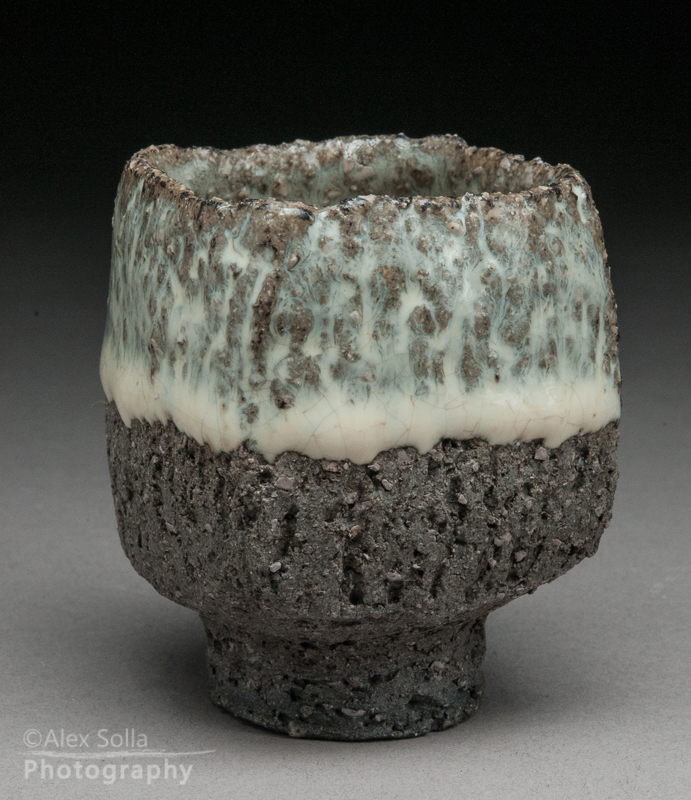
Just posting a few more images of the pots I uncovered after unpacking those crates that had been buried on my front porch for the past decade.  Considering that this first image is of a whiskey cup (or sake if you prefer) from John Neely, and is quite small, you can tell that the clay is groggy beyond words! It is more like stone or asphalt. Rough and gnarly! This one was fired in a reduction cooling kiln.


This is a woodfired mug, by Jason Hess, woodfirer extraordinaire. This mug came out of a firing where Jason was testing out new wood for the woodkiln. He'd been firing with cottonwood for a while, but the firing crew was seeing weird blue drips on the underside of the kiln shelves post-firing... so they switched to firing scrap wood from this building site... so suddenly there was oak and pine aplenty, which completely changed the color response from the claybody.


Tuesday, January 8, 2013

Three Pots from Chris Baskin


Chris Baskin was a grad student at Alfred while I was there as a "special student". Chris had apprenticed with Byron Temple, which in my mind, enabled him to walk on water. Having used only a few of Byron's pots, the sensibilities shared are immense.

Whenever I asked Chris if I could sit and watch him pull handles, he always made it seem like "no big deal, handles are easy, no problem"... and I struggled for another five years before I began to find my own handles. Looking back now, I see so many things in Chris' pots that I borrowed or stole outright. I doubt he has any idea of what an inspiration he was to me during that seminal period at Alfred.

Chris Baskin's website has his current work available as well as his thoughts on various firing methods, etc.
Definitely worth a read! http://chrisbaskin.com


Monday, January 7, 2013

Sake Set from Shigaraki, Japan


I just figured I would share a few more images from pots in our collection that we re-discovered a few weeks ago.

This sake set was given to me as a gift (and no, they are not looking for a new home). They were made in Shigaraki, Japan. I have always wanted to go to Shigaraki. I love the roughness of the clay; the woodfire marks, the ash drips... it was what I hoped to create in my own woodfired work.


Sunday, January 6, 2013

More Pottery Looking for a New Home


This carved dinner plate and tumbler are up for grabs  going to a new home. You can either pick it up here at the studio, or arrange for packing and shipping. Yay for local pickup!

Tuesday, January 1, 2013

You Slow, Slow Bastards

No, I am not being humorous here.

I posted all these cool pots here on my blog, and no one has really said much of anything.

I posted them 2 min ago on FB and they are FLYING off our shelves.

You know what? That'll teach me.

Blogs suck.

Monday, December 31, 2012

No More Mac & Cheese


When I first made this casserole, I had never joined a thrown form to a slab successfully. Most of the time, I could be assured that there would be some cracking; either an S-crack in the middle or a crack along the seam where the thrown cylinder joined the slab. After trying all sorts of solutions, I tried just dropping the freshly thrown cylinder on the wet slab and leaving them to dry together before doing anything.... and lo-and-behold... it worked. These forms would later morph into my oval baking dishes and my oval pitchers and my oval vase forms.

This is a very used casserole. It was woodfired, with only a liner glaze on the inside. It has seen mostly mac and cheese in its day. Now that I no longer consume pasta and cheese with regularity, it is time for this handsome casserole to find a new home. I give no guarantees about it lasting another decade or two, going in and out of an oven and all the temperature extremes. So far, it has been very accommodating of thermal shock. I would imagine, if you continued baking with it, and NOT preheating the oven, it would last quite a long while still.

This casserole is up for grabs. Pay the postage on it, or come pick it up.

Saturday, December 29, 2012


This was the second cup I ever purchased. This was a "second" being sold as a first in a gallery in Northampton MA, back in 1990. Bill Campbell's pots are found almost everywhere in this country. http://www.campbellpottery.com/index.html

Up for grabs.

Friday, December 28, 2012

Other Pots Needing New Homes


Woodfired, but beyond that, I can't remember much. I am mortified that I can't recall who made this. Definitely happened in Utah. Hand sized. Makes a nice cup.


Not a terribly large jar. Great for a small batch of cookies. I think this was made by Tony Clennell but I am not sure. One of my students glazed it at the end of the year when we were emptying shelves and tossing bisqueware.


I can't recall who made this. Tall mug. Nice airbushed blue glaze over Oatmeal, cone 10, reduction.

All of these pots are up for grabs. Pay for shipping or come out to the studio to pick them up. Who ever claims them, gets them. I'll edit this post to reflect when they are gone.

Thursday, December 27, 2012

Two More Pots Looking For a New Home


This gnarly jar was made by Testuya Yamada, back when he and I were "special students" at Alfred University. This is not a light jar. If you think you want it shipped, I will need a note from your doctor, proving that you have full control of your faculties. (Wood fired, cone 10, with Oribe glaze)


This was made by David Kingsbury, from Ithaca, NY. Cone 10, matte glazes. Quite large; holds more than half a gallon.

Wednesday, December 26, 2012

Should've Taken Better Notes


I feel like a failure. I look at these pots and I remember the faces that made them, but the names escape me. I think the small mug above was made by Wil Shykaruk from Canada, but it doesn't have his usual chop.  The rest of the pots in this post are anonymous.


This pot has found a new home. YAY!


 The last image is of the very first cup I ever purchased.  My girlfriend at the time, Jen, found it for me in a gallery in Port Townsend. She wanted me to make work like this. Yeah. Not so much.

All of these pots need to find new homes. Prefer local adopters, but if you want to pay USPS or FedEx to get it home, we can arrange for that too.

Saturday, December 22, 2012

Other Pots From Our Collection


This mug is one of Jason Walker's from back when we were in school together at Utah State in Logan. This is one of the most amazing examples of freehand brushwork I have ever seen. If I remember right, Jason was working for a sign-painter doing hand-painted signs. What a way to learn the skill of the brush! Inside, where the lens couldn't quite see, is a stunning penguin, staring up from the last bits of my morning's green tea.